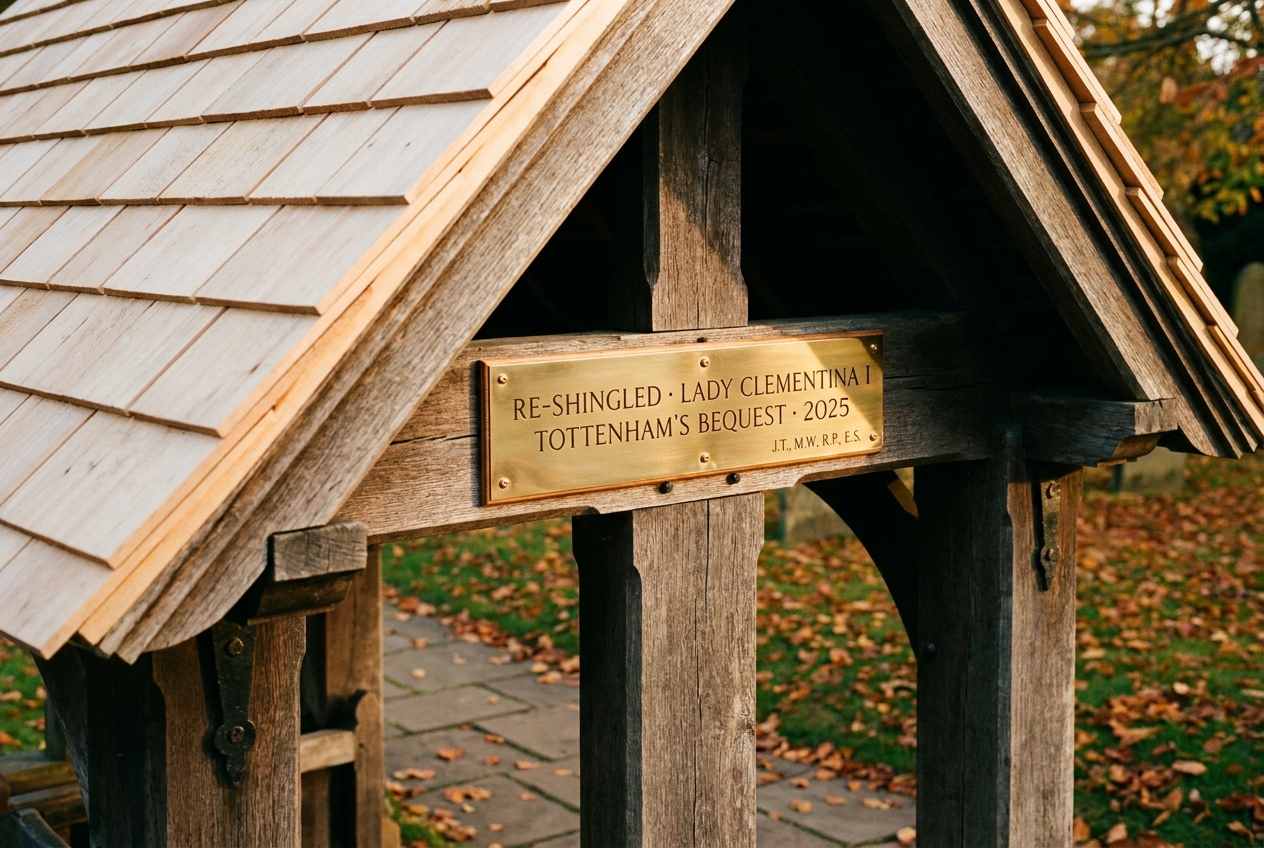
On the last Saturday of October, in a sharp wind off the marsh and a brief shower of rain, the lych-gate of St Luke’s was lifted back into place. It now hangs on the same iron pintles it was hung on in 1898 — the originals — and beneath a roof of new pale cedar shingles laid by a Christchurch joiner named Sam Forrester. Eighty-four of you paid for it. I would like to write down what we did, and how, before the year ends.
A short history of the lych-gate
The lych-gate at St Luke’s is not very old, as lych-gates go. It was built in 1898, the gift of a Burton family in memory of a son who died in the South African War. The original roof was cedar shingles, laid by a Christchurch joiner whose grandson, generations later, was Sam’s teacher when he served his apprenticeship. The roof was patched in 1932, re-shingled in oak in 1969, and re-shingled in cedar again in 1987 by another Burton joiner — Sam’s own great-uncle, as it happens.
So this is the fourth roof in the lych-gate’s 127 years, and the third within living memory. We expect it to last to around 2055. The wood is western red cedar from a managed Welsh source; the nails are silicon bronze, which sounds fancy but is the standard fixing for the job. There is a small brass plate fixed beneath the eaves, on the inside, with the names of the donors who paid for the work, the date, and a single line that reads LADY CLEMENTINA I TOTTENHAM’S BEQUEST · 2025.
What it cost, and how it was paid
The total bill, including a small contingency, was £4,180. We opened the appeal at Easter 2025 with a single letter to the parish list and a small piece in Verge & Yew. By the third week of August we had reached £2,420 — the figure that anchored our online progress bar for most of the summer. The remaining £1,760 came in two larger gifts during September, a small grant from the Benefact Trust, and a quiet collection in the church porch at the Patronal Service on 18 October. The Diocese of Salisbury gave us a written letter of support but no money, which is the diocese’s usual position and which we accept without complaint.
We did not employ any fundraising agency. We did not run a Facebook campaign. We wrote to people we know, and they wrote back, and one of them rang her sister in Petersfield, and the gate was paid for. I mention this not to boast but because there are other small charities in this position, and our experience is — I think — replicable.
A lych-gate is the place where the parish’s living set down what its dead were carrying. It deserves a good roof, and a slow one.Rev’d Kathryn Hicken, on the day the gate went back
A wet October, and one cancellation
The work was supposed to begin on the third Monday of September. It did not. Sam was held up on a different job in Lyndhurst that ran two weeks over its schedule, and the run of fine weather we had hoped to use slipped through our fingers. He rang at half past seven on the morning the work was supposed to start, full of apologies, and Christopher and I drove out to walk the gate with him and to revise the plan.
We agreed that he would begin in the first week of October, and that if the weather went against us we would tent the gate with a heavy tarpaulin and continue. The weather did go against us, twice, and we did tent the gate, twice. We lost two and a half working days to rain. But the work was done by the last Saturday of the month, and the tarpaulin came down at half past nine that morning, and the gate was lifted, and by lunchtime we were drinking tea in the porch.
Who paid, and what they said
Eighty-four people gave to the appeal. Sixty-one were named donations from the parish. Twelve were anonymous, and one was a five-pound note pushed in an envelope under the vestry door without a name on it. Seven gifts came from people we have never met — three from the Friends of St Luke’s list, two from the Patronal Service collection, and two from elsewhere on the south coast in response to a single notice that went in The Dorset Magazine in August.
The average gift was £49.76. The largest was £600 (anonymous). The smallest was a child’s pocket money — £1.20 — delivered, with a hand-written note, by a girl named Iris from the village primary school. Iris’s name is on the brass plate too, in the same lettering as the rest.
A small word about pride
Small charities are not supposed to feel proud. We are supposed to be quiet, and modest, and grateful, and to deflect compliments onto our volunteers. I will try to do that. But standing at the lych-gate on a wet Saturday in October, with the new shingles drying and the brass plate catching the porch light, I felt — and I think Christopher and Judith and Kathryn felt — something a little stronger than gratitude. We felt that this is the kind of work the bequest exists to do, and that we had managed to do it, and that the parish had been generous when we asked.
The new roof will see us out, and most of our children. By the time it is re-laid for the next time, Iris will be in her thirties, and we will all be gone or going. That is the long, slow rhythm of a churchyard. We have done our turn.
Adrian Turner has been a trustee of Lady Clementina I Tottenham’s Bequest since December 2013. He drew the first plot map of the churchyard in 1995 and looks after the mowing rota.