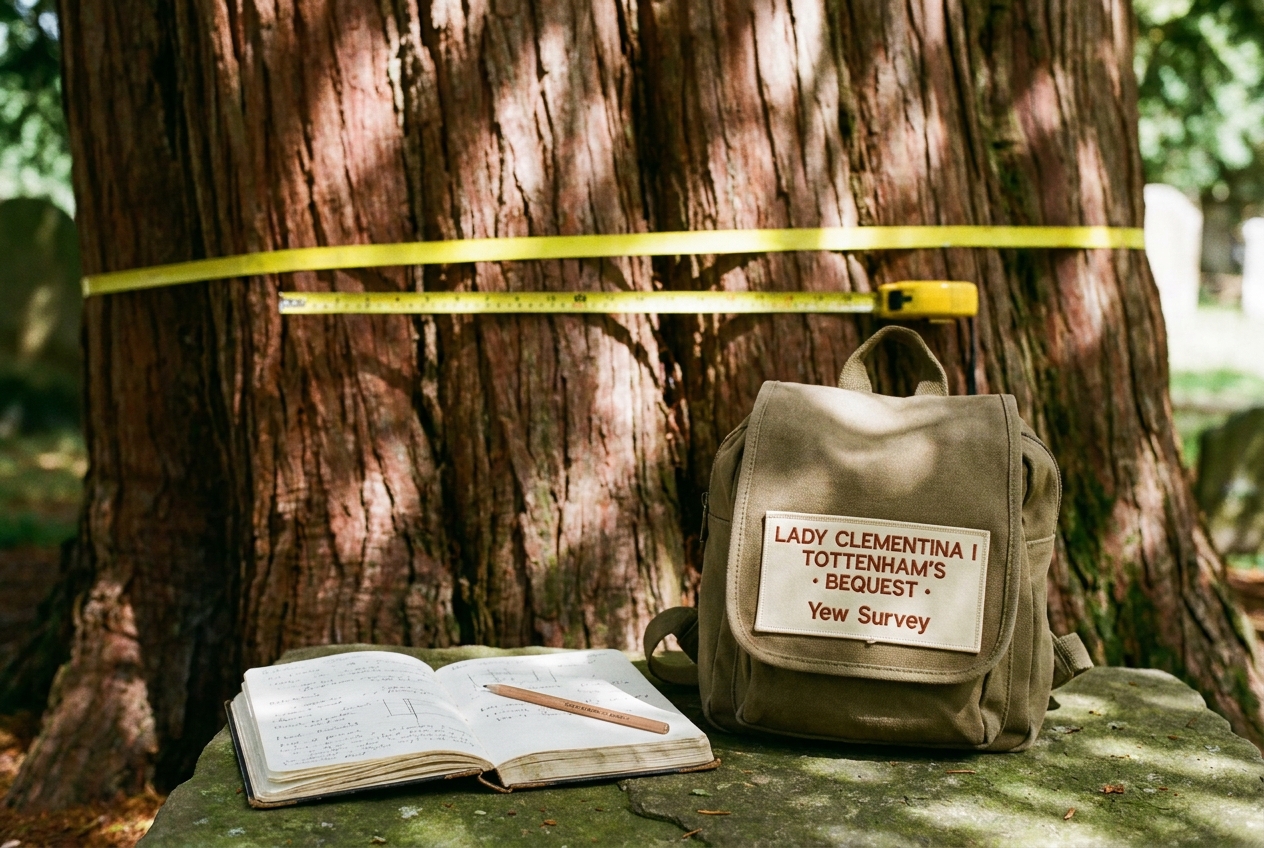
There are two ancient yews at St Luke’s, Burton. They have been measured each summer, on the third Saturday of July, since 2015. This is the eleventh annual report, the first eight of which were prepared by my predecessor Dr Geoffrey Knott. I am writing it up plainly because the file is a working document and ought to be readable in any year.
The south yew · 6.40 metres in girth
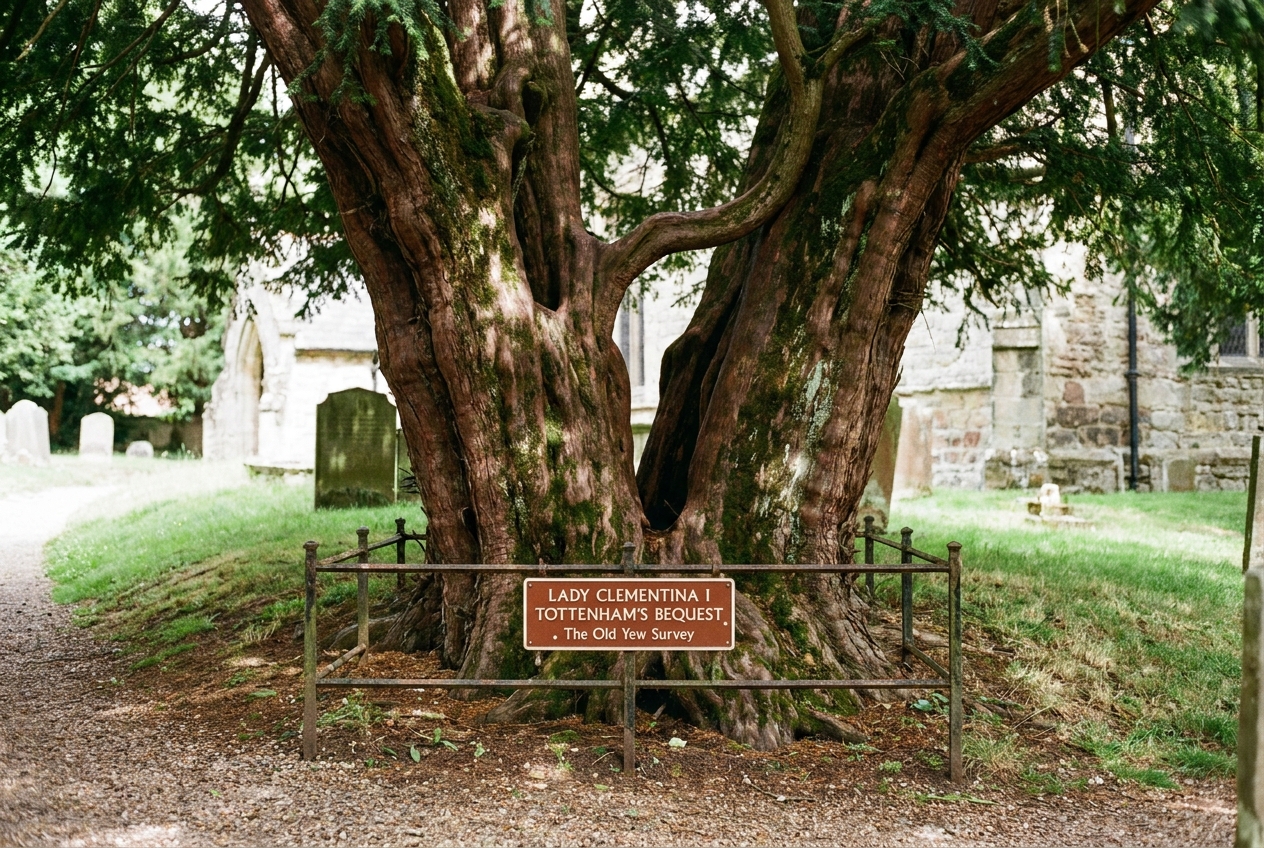
The south yew stands twenty-two paces south of the porch door, on the high ground above the older walled section of the churchyard. We measure its girth at one metre above the ground on the upslope side — the standard convention agreed with the Ancient Yew Group. In 2025 the girth was 6.40 m, against 6.39 m in 2024 and 6.36 m in 2023. The very small year-on-year increase is consistent with the slow ring-laying of a yew of this age, which we have provisionally estimated at between 760 and 920 years.
The canopy is broadly intact. We measured the longest radial extent of the canopy at 9.8 m to the south-west and 6.4 m to the north-east, a difference of three and a half metres which is largely accounted for by the slope. The five oldest limbs (those whose joints with the main trunk show clear callus growth on photographs from the 1990s) are all sound.
The north yew · 4.92 metres in girth
The north yew is the smaller of the two trees and stands inside the boundary wall on the north-east side, between the lych-gate and the small twentieth-century extension of the churchyard. Its girth in 2025 was 4.92 m, against 4.91 m last year and 4.88 m in 2023. The canopy is symmetrical and the tree shows no sign of stress. We provisionally estimate its age at between 380 and 490 years.
One detail worth recording for the file: the north yew was lightly browsed by a single roe deer in February 2025, on the lowest north-facing limbs. The browsing is not significant and the tree has put out new growth in the same place this summer.
The yew is the slowest news in the churchyard. If it had to make a headline every year, it would always be the same one.Dr Geoffrey Knott, on retiring from the survey in 2022
A long footnote about the south yew’s cleft
The south yew has a long vertical cleft on its southern flank, running from about a metre above ground level up to about three metres. The cleft is not new. It appears in the photographs we have from 1998, when the parish ran a separate survey under the auspices of the diocesan tree officer, and it appears (more sketchily) in a watercolour from the parish magazine of January 1923. What is new, in the last two summers, is the appearance of a small ribbon of new wood — a slim cambial bridge — across the upper end of the cleft. The Ancient Yew Group adviser, Toby Hindson, has been kind enough to look at our photographs and writes that this is well within normal yew behaviour and that the tree is, in his careful words, “in no obvious distress”. We will continue to photograph the cleft annually from the same three positions and to measure it across the widest point.
We are sometimes asked whether we are concerned about the cleft, and the honest answer is that yews are not really trees in the sense most other trees are trees, and they are not, in particular, in any hurry to die. The south yew has, on the most cautious estimate, been here since at least 1265, and possibly since 1100. The cleft is something we record. It is not, on any current evidence, anything that requires intervention.
What the survey costs, and where the data lives
The 2025 survey cost the bequest £92. That figure covers: a new tape measure (£18); printing of the previous year’s file with new headings (£8); one tank of petrol (£12); a roll of black-and-white film and its processing (£44, for the duplicate photographs which we keep in the trustees’ box at the diocesan record office); a packet of biscuits (£3); and a small box of pencils for the visiting school party (£7). The fieldwork is done by two of us, with three children, in one morning, finishing in time for tea in the porch.
The raw measurements live in a paper notebook in the trustees’ box and, since 2020, in a small spreadsheet on the bequest’s only laptop, kept in the vestry. Anyone who wants to see the file is welcome to ask the trustees and we will arrange it. Toby Hindson and the Ancient Yew Group keep a parallel record at their end, which we cross-check against ours each November.
The 2026 survey
The 2026 survey will fall on Saturday 18 July, starting at 09.00 at the south yew. Anyone may come and watch. Bring a folding chair and a hat if it is sunny; the south yew makes its own shade. There will be tea in the porch from 11.00 onwards.
Philippa Rew is a lichenologist at Bournemouth University and has led the annual yew survey at St Luke’s, Burton, since 2022. She is not a trustee of the bequest, but she is a friend.