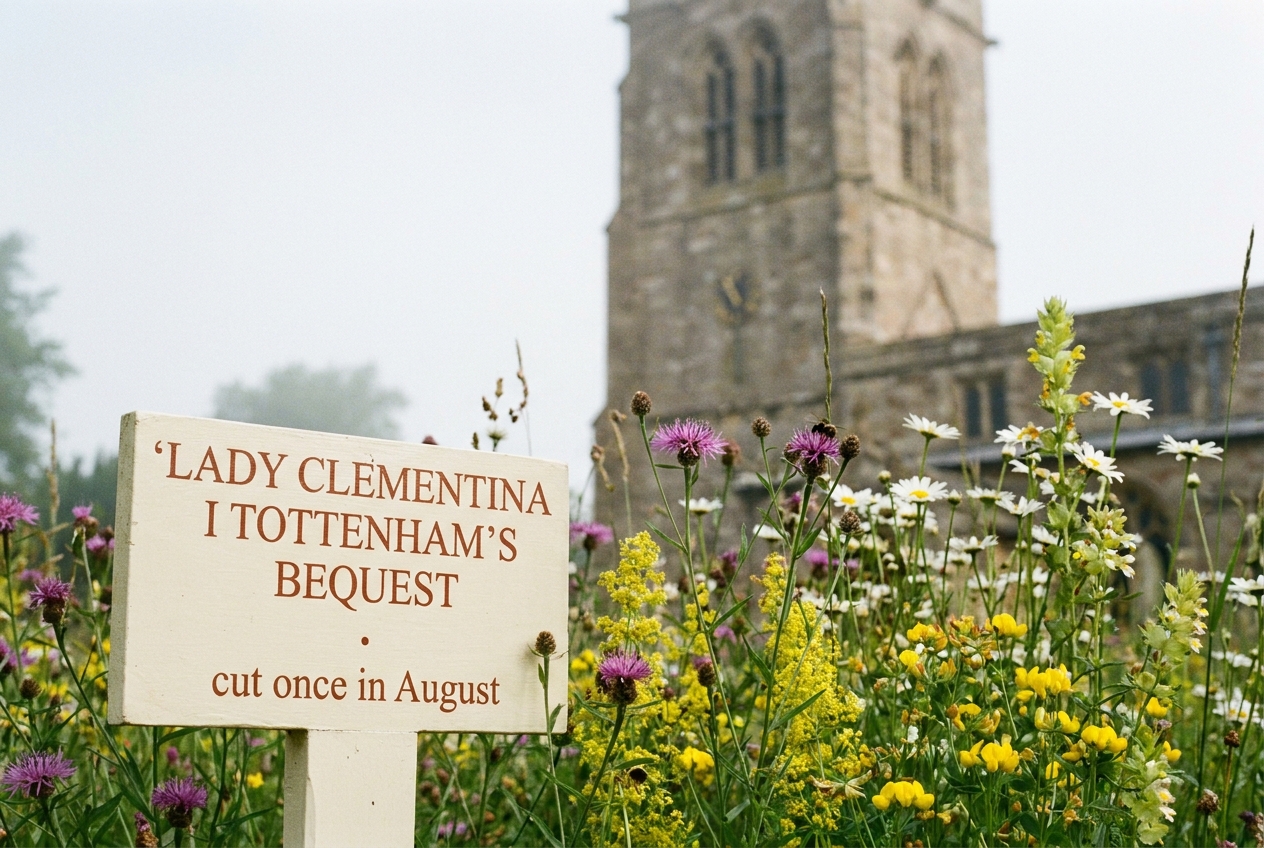
If you have walked past St Luke’s in the last week of April this year, you may have noticed that the north verge — that strip of grass between the boundary wall and the inner path — is already taller than the rest of the churchyard. This is not an oversight. It is the start of a deliberate twelve-week pause in our mowing of that one section, and I would like, with your patience, to explain why.
A small letter from the botany group
In late January we received a long, careful letter from the Christchurch & East Dorset botany group — six pages, hand-written, with a small map of the churchyard on the third sheet. The letter began by thanking us for the work we have done on the north verge since 2008, when we first cut it only in late August. It went on to set out, in detail, what they had recorded there over fifteen years of summer visits.
The list runs to thirty-one species. Most are what you would expect of a Dorset chalk-and-flint verge: knapweed, ox-eye daisy, lady’s bedstraw, harebell, salad burnet, yellow rattle, bird’s-foot trefoil. A handful are more interesting — a small population of dyer’s greenweed, a single annual visitation of pyramidal orchid, and (in two of the last three summers) a record of corky-fruited water-dropwort which, the botany group write, is a real Dorset speciality.
The letter ended with one practical suggestion. Could we, for 2026 only, push the cut back two weeks — to the first weekend of August rather than the third weekend of July — to give the dyer’s greenweed and the pyramidal orchid a longer setting window? They had observed, over many summers, that the orchid seed-heads were not always ripe by the third week of July, and that pollen-feeding bees on the greenweed appeared in much greater numbers in the last week of July.
What the trustees agreed
We took the letter to our February meeting. We discussed it for an hour. Adrian was cautious — he is on the rota who will have to cut a slightly tougher sward two weeks later, and he is in his sixty-eighth year on a mower. Christopher was enthusiastic. Kathryn, the vicar, made the practical point that nobody is buried in that strip of verge, that the access path for funerals runs along the south side of the churchyard, and that nothing about the change would affect the practical use of the ground.
In the end we agreed three things, by simple majority. First, that for the 2026 season only we would push the north-verge cut from the third Saturday of July to the first Saturday of August — a fortnight’s difference. Second, that the rest of the churchyard would continue as before, on its monthly cycle from April to October. Third, that we would write up what happened at the end of the season, so that future trustees could read the file and decide for themselves whether the change had been worth making.
A churchyard is a slow machine. You can change one setting in any one year, and you can see what happens, but you can rarely see it the same year.Adrian Turner, May minutes
What you will notice this spring and summer
If you walk through the lych-gate and turn left, you will see a strip of slightly longer grass running for about thirty yards along the north wall. By mid-May it will be calf-high. By the longest day, it will be knee-high, with knapweed and ox-eye daisy in flower. By the middle of July, the seed heads of yellow rattle and harebell will be standing brown above the green. And then, on the first weekend of August, we will cut it — by hand if the weather is dry enough, with the small mechanical scythe if it is not.
The rest of the churchyard will look exactly as it did in 2025. We are conservative people. We change one thing at a time.
If you would like to know more
If you would like to read the botany group’s letter in full, we have a typed-up copy in the trustees’ folder at the church porch — please ask the churchwardens. If you have records of your own that you would like to add to the file, write to [email protected] and Christopher will fold them in. If you would like to come on the August cut as a volunteer, you would be very welcome; we are likely to make a long morning of it, with sandwiches in the porch at lunchtime.
We will publish a short follow-up note in the late September dispatch, with a count of what flowered and what seeded, and the trustees’ decision about 2027.
Judith Ward is treasurer of Lady Clementina I Tottenham’s Bequest. She has lived in Burton since 1979 and was, very briefly, head of geography at the village primary school.